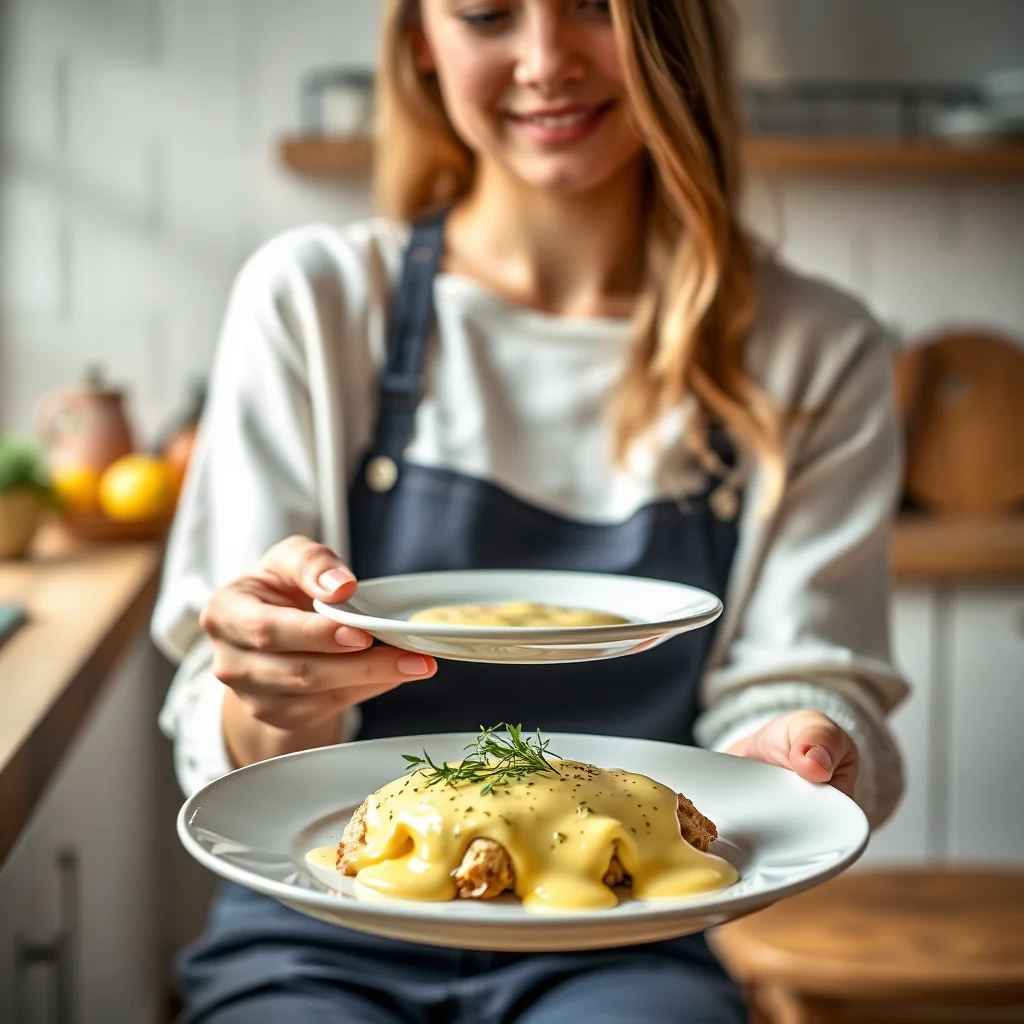
Silky restaurant-worthy hollandaise sauce is less intimidating than its reputation: egg yolks, lemon, and butter emulsified into liquid gold in fifteen minutes. The double boiler does the diplomacy. Make it once, and brunch at your house changes forever.
Hollandaise sauce—that rich, creamy, liquid gold that transforms simple steamed asparagus or a perfectly poached egg into a brunch masterpiece. It has a reputation for being finicky, but don’t let that scare you! With a little patience and my step-by-step guide, you’ll be whisking up a silky, restaurant-worthy Hollandaise in your own kitchen. Let’s conquer this classic sauce together!
Ingredients
• Yields: about ¾ cup / 180 ml (6.1 fl oz)
• 3 large egg yolks
• 1 to 1.5 tablespoons / 15 to 22.5 ml (0.8 fl oz) fresh lemon juice
• 1 pinch white pepper
• 1 tablespoon / 14 g (0.49 oz) butter, cold and cubed
• 7 tablespoons / 98 g (3.46 oz) butter, melted
• salt to taste
Instructions
1. In the top of a double boiler (or a heatproof bowl set over a saucepan of simmering water), whisk the egg yolks until they are pale and creamy. Whisk in 1 tablespoon / 15 ml (0.5 fl oz) of the lemon juice and the pinch of white pepper.
2. Place the bowl over hot, but not boiling, water. Add the 1 tablespoon / 14 g (0.49 oz) of cold butter. Whisk constantly, scraping the sides and corners of the bowl, until the butter melts and the mixture thickens to the consistency of a light custard. Gentle, consistent heat is key to prevent scrambling.
3. Once thickened, begin adding the melted butter, a few drops at a time, while whisking continuously. It’s crucial to add the butter slowly at first to create a stable emulsion. If the sauce looks like it might be curdling, immediately lift the bowl off the heat and whisk vigorously for a moment before returning.
4. As the sauce begins to thicken and look glossy, you can start adding the remaining melted butter in a thin, steady stream, still whisking constantly. Continue until all the butter is incorporated and the sauce is smooth and airy.
5. Remove the sauce from the heat. Season to taste with salt and the remaining ½ tablespoon / 7.5 ml (0.3 fl oz) of lemon juice, if desired.
6. Serve immediately over your favorite roasted vegetables, poached eggs, or potatoes for a truly decadent meal.
Nutritional Information
• Serving Size: 1 tablespoon, Calories: 75, Fat: 8g (0.28 oz), Saturated Fat: 5g (0.18 oz), Cholesterol: 60mg, Sodium: 65mg, Carbohydrates: 0.1g (0 oz), Protein: 1g. (0.04 oz) (Values are estimates and may vary).
Pro Tips for Success
• for Perfect Hollandaise
• The water in your double boiler should be hot and steaming, but never boiling. Boiling water will cook the eggs too quickly and cause them to scramble.
• Add the melted butter extremely slowly, especially at the beginning. Drizzling it in drop by drop is key to forming a stable, creamy emulsion.
• If your sauce breaks or separates, place 1 teaspoon (5 ml / 0.2 fl oz) of lemon juice in a clean bowl. Whisk in 1 tablespoon (15 ml / 0.5 fl oz) of the broken sauce until it’s creamy, then slowly whisk in the rest of the sauce, a little at a time, to bring it back together.
• For an even more stable and richer sauce, use clarified butter (ghee). This removes the milk solids and water, which can sometimes cause the sauce to break.
FAQ
Q: Is this Hollandaise sauce recipe vegetarian
A: Yes, absolutely. This classic Hollandaise sauce is 100% vegetarian. It is made from egg yolks, butter, and lemon juice, making it a perfect lacto-ovo vegetarian sauce to elevate vegetables and brunch dishes.
Q: What are the best vegetarian pairings for Hollandaise sauce
A: Hollandaise is fantastic on a wide variety of vegetarian foods. It’s traditionally served over poached eggs for Eggs Benedict and steamed or roasted asparagus. It’s also delicious drizzled on roasted broccoli, artichoke hearts, new potatoes, or savory tofu scrambles.
Q: Can I make this Hollandaise sauce vegan
A: This specific recipe relies heavily on egg yolks and dairy butter for its structure and flavor, so it cannot be made vegan with simple substitutions. To create a vegan Hollandaise, you would need a different recipe that typically uses a base of cashews, silken tofu, or a vegan butter and plant-milk roux, along with nutritional yeast and black salt (kala namak) for an ‘eggy’ flavor.
Q: How should I store leftover vegetarian Hollandaise sauce
A: Hollandaise is best enjoyed immediately after making it. Due to the raw egg yolks and delicate emulsion, it does not store well and can pose a food safety risk. If you must store it, place it in an airtight container in the refrigerator for no more than 24 hours. Reheat it very gently in a double boiler, whisking constantly, but be aware the texture may not be the same.
Silky Restaurant-Worthy Hollandaise Sauce
Ingredients
Method
- In the top of a double boiler (or a heatproof bowl set over a saucepan of simmering water), whisk the egg yolks until they are pale and creamy.
- Whisk in 1 tablespoon / 15 ml (0.5 fl oz) of the lemon juice and the pinch of white pepper.
- Place the bowl over hot, but not boiling, water.
- Add the 1 tablespoon / 14 g (0.49 oz) of cold butter.
- Whisk constantly, scraping the sides and corners of the bowl, until the butter melts and the mixture thickens to the consistency of a light custard. Gentle, consistent heat is key to prevent scrambling.
- Once thickened, begin adding the melted butter, a few drops at a time, while whisking continuously. It's crucial to add the butter slowly at first to create a stable emulsion. If the sauce looks like it might be curdling, immediately lift the bowl off the heat and whisk vigorously for a moment before returning.
- As the sauce begins to thicken and look glossy, you can start adding the remaining melted butter in a thin, steady stream, still whisking constantly.
- Continue until all the butter is incorporated and the sauce is smooth and airy.
- Remove the sauce from the heat.
- Season to taste with salt and the remaining ½ tablespoon / 7.5 ml (0.2 fl oz) of lemon juice, if desired.
- Serve immediately over your favorite roasted vegetables, poached eggs, or potatoes for a truly decadent meal.
- Add the melted butter extremely slowly, especially at the beginning. Drizzling it in drop by drop is key to forming a stable, creamy emulsion.