
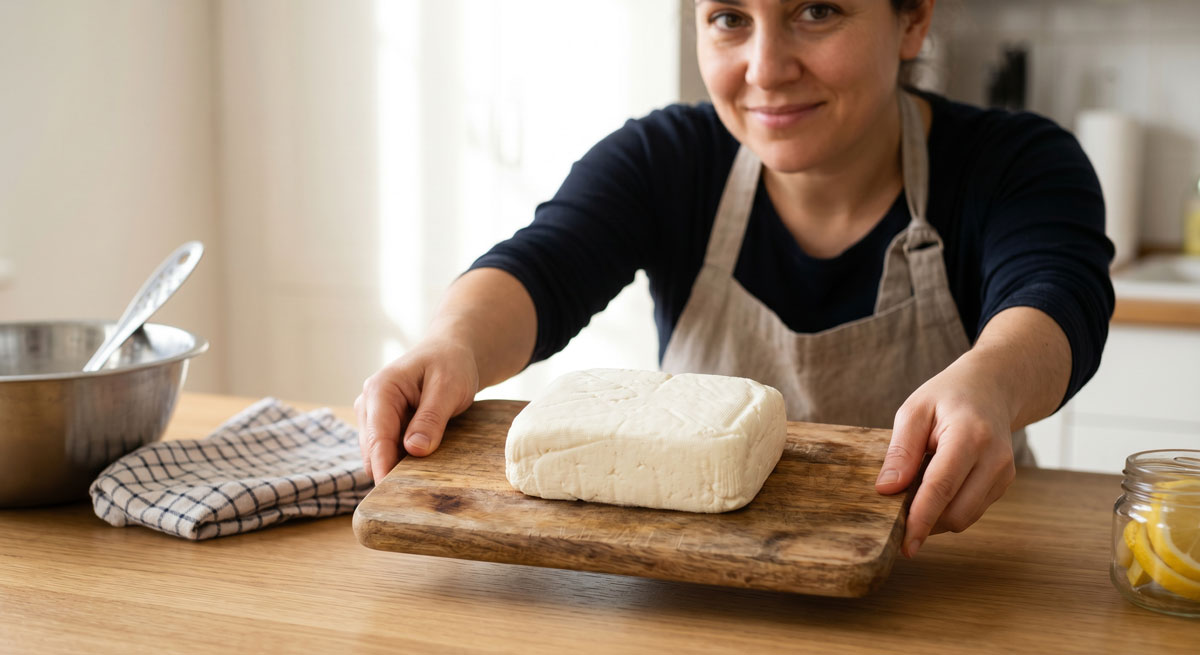
Ingredients
- Whole Milk: 8 cups (64 oz / 1892g)
- Fresh Lemon Juice (or Citric Acid Solution): 0.25 cups (4 tbsp. / 12 tsp. / 2 oz / 57g)
- Hot Water (optional, for softer curds): 1.5 cups (12 oz / 340g)
Step-by-Step Instructions
- Pour 8 cups (64 oz / 1892g) of whole milk into a heavy-bottomed 4-quart (128 oz / 3785g) pan that allows plenty of room for boiling. Set it over high heat and bring the milk to a full, foaming boil, stirring often to prevent scorching and sticking.
- Reduce the heat to low and, before the foam subsides, drizzle in 0.25 cups (4 tbsp. / 12 tsp. / 2 oz / 57g) of fresh lemon juice or your chosen acid solution. Very gently and slowly move the spoon through the milk in one direction.
- After 10 to 15 seconds, remove the pan from the heat and continue to gently agitate the milk until large lumps of soft curd form. If the cheese has not formed after 1 minute, place the pan over the heat momentarily until the casein coagulates from the pale yellow whey, adding an extra 0.1 cups (1.6 tbsp. / 4.8 tsp. / 0.8 oz / 22g) of your acid agent if necessary.
- As soon as the cheese has formed, remove the pan from the heat, cover, and set aside for 10 minutes. If you want a very soft cheese, gently pour in 1.5 cups (12 oz / 340g) of hot water. When the cheese has settled under the surface of the whey, it is ready to drain.
- Line a colander with 3 thicknesses of cheesecloth or a large white handkerchief that has been dipped in water and wrung dry. Drape the corners and edges of the cloth to hang over the sides of the colander. Place it in a sink or over a bowl to catch the whey.
- Remove the large lumps of cheese with a slotted spoon and place them in the colander. Gently pour the smaller pieces and remaining whey into the colander.
- Gather up the corners of the cloth and twist 1 to 2 times around. Hold the cheese under a gentle stream of lukewarm tap water for 5 to 10 seconds to rinse off the cutting agent. Gently twist the cloth to squeeze out the excess whey.
- To drain the curd in the cloth, bind it with enough twine to hang it from a faucet over an empty sink for 2.5 to 3.5 hours. To drain under weight, bind the cloth around the curds, place in a colander, and rest a kitchen-scale weight or water bowl on top of the cheese, pressing for 0.75 to 1.5 hours (45 to 90 minutes).
- Unwrap the cheese and use immediately as directed in your favorite recipe, or wrap tightly in paper-towel-lined plastic wrap or zip-lock bags and store in the refrigerator for up to 4 days.
Nutritional Information
Please note: The following nutritional values are approximate and based on a standard 2 oz (56g) serving of the final compressed cheese. Much of the milk's lactose (carbohydrates) drains away with the whey, leaving behind the rich proteins and fats!
- Serving Size: 2 oz (56g)
- Calories: 165 kcal
- Carbohydrates: 2g
- Protein: 11g
- Fat: 13g
Chef's Pro Tips
As a chef who has made this all over the world, I can tell you that cheese making is an art, but it's an incredibly forgiving one. Here are my top secrets to ensure your Homemade Panir Cheese turns out beautifully every single time.
1. Choose the Right Milk for Homemade Panir Cheese
Always opt for the highest quality, full-fat whole milk you can find. Farm-fresh, Jersey, or Guernsey milk yields a rich, creamy curd. Avoid ultra-pasteurized (UHT) milk if possible, as the high heat treatment alters the protein structure, making it difficult for the milk to curdle properly.
2. Master the Acid Balance in Your Homemade Panir Cheese
If your finished cheese tastes sour or lemony, you likely used too much curdling agent or didn't rinse the curds thoroughly. Conversely, if your milk isn't separating into clear whey and solid curds after a minute, simply add a tiny bit more acid (1 tsp at a time) and apply a gentle flash of heat.
3. Control the Texture of Your Homemade Panir Cheese
The softness of your panir is completely in your control! If you want a melt-in-your-mouth, delicate texture for scrambling or soft curries, add hot water right after the curds form and don't press it with heavy weights. If you need firm cubes for grilling or frying, drain it thoroughly and press it under a heavy weight for the full 90 minutes.
4. Save the Whey from Your Homemade Panir Cheese
Don't pour that liquid gold down the drain! The pale yellow whey left behind is incredibly nutritious. You can use it to knead dough for chapatis or naan, use it as a broth base for soups, or even let it sour naturally at room temperature for a few days to use as the acid reagent for your next batch of cheese.
Frequently Asked Questions (FAQ)
Why is my Homemade Panir Cheese crumbly and tough?
A tough or crumbly texture usually happens for three reasons: using low-fat milk, boiling the curds for too long after the acid was added, or pressing the cheese under too much weight for too long. For a softer block, remove the pan from the heat the second the curds separate from the whey.
How long does Homemade Panir Cheese last in the fridge?
When wrapped tightly in paper towels and sealed in an airtight plastic container or zip-lock bag, your fresh panir will stay delicious in the refrigerator for up to 4 days. If the paper towels get overly damp, swap them out to keep the cheese fresh.
Can I freeze Homemade Panir Cheese?
Yes, you absolutely can! Cut the pressed cheese into your desired cube sizes and freeze them in a single layer before transferring to a freezer-safe bag. It will last up to 3 months. Keep in mind that freezing alters the texture slightly, making it a bit more porous and spongy—which is actually fantastic for soaking up rich, flavorful curry sauces!