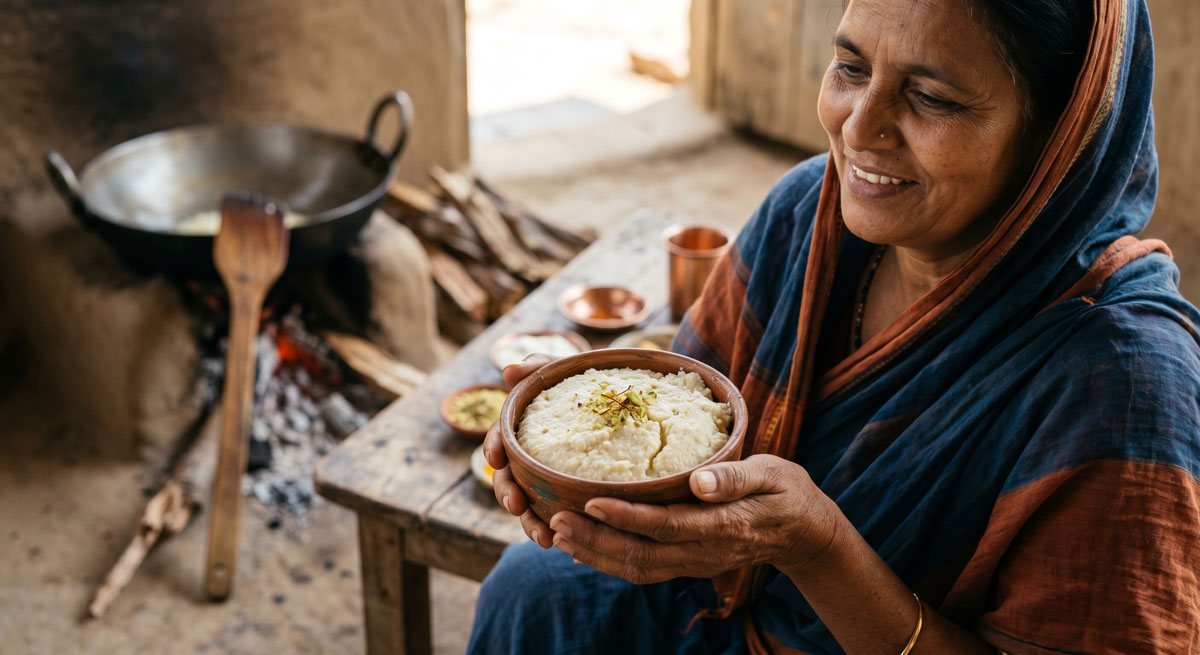
Ingredients and Equipment
- Whole Milk: 4.0 cups (32.0 fl oz / 946 ml)
- Sugar: 0.0 tbsp (0.0 g) — This is a traditional unsweetened base.
- Expected Yield: Approximately 6.0 oz (170.0 g) of finished Khoa. (To double the recipe, use 8.0 cups / 64.0 fl oz / 1.9 liters of milk to yield roughly 12.0 oz / 340.0 g).
- Equipment: 1.0 wide wooden spatula and 1.0 heavy 4.0 to 6.0-quart (128.0 to 192.0 fl oz / 3.8 to 5.7 liters) nonstick saucepan.
Step-by-Step Instructions
- Pour exactly 2.0 cups (16.0 fl oz / 473 ml) of the whole milk into your heavy nonstick saucepan. Stirring constantly with a wide wooden spatula, bring the milk to a full foaming boil over high heat. Continue stirring to prevent it from sticking to the bottom or forming a skin on the surface. If necessary, reduce the heat slightly to prevent spilling, and boil vigorously for 12.0 to 15.0 minutes.
- Add the remaining 2.0 cups (16.0 fl oz / 473 ml) of milk to the pan. Continue stirring continuously to bring the milk back to a full boil, and maintain this vigorous boil for another 10.0 to 12.0 minutes.
- Reduce the heat to a moderate setting and continue to boil the milk until it noticeably thickens to the consistency of heavy cream.
- While still stirring vigorously, lower the heat again. Cook the milk until it reduces to a slightly sticky, thick, pasty mass that actively draws away from the sides of the pan.
- Remove the pan from the heat. You can immediately use the hot Fresh Milk Fudge Khoa in your favorite sweet recipe, or transfer the 6.0 oz (170.0 g) yield to a platter. As it cools to room temperature, the paste will firm up into a thick, fudge-like consistency.
Nutritional Information
Note: The following values are approximate and based on a 1 oz (28g) serving size (yields about 6 servings from 4 cups of whole milk).
- Calories: 100 kcal
- Carbohydrates: 8g
- Protein: 5g
- Fat: 5g
Pro Tips
- Invest in the Right Pan: As a chef, I cannot stress enough how crucial a high-quality, heavy-bottomed, nonstick pan (like Silverstone) is for this recipe. Thin pans will distribute heat unevenly and cause the milk to scorch, ruining the delicate flavor of your sweet base.
- Master the Stirring Technique: Use a wide wooden spatula with a flat edge. This allows you to constantly scrape the entire bottom and sides of the pan effectively. Rhythmic, continuous stirring prevents a skin from forming and keeps the milk solids from catching and burning.
- Control the Boil: You want a vigorous, rolling boil to evaporate the water quickly (37 percent by weight needs to cook off!), but you must watch it like a hawk. Adjust the heat up and down slightly as needed to prevent the milk from frothing over the edges.
- Know When to Stop: The residual heat of the pan will continue to cook the Khoa even after you take it off the stove. Remove it from the heat as soon as it forms a cohesive, pasty mass that pulls away from the sides. Overcooking at the final stage will result in a crumbly, dry texture rather than a creamy fudge.
Frequently Asked Questions (FAQ)
What is the difference between Fresh Milk Fudge Khoa and Mawa? There is no difference! "Khoa" and "Mawa" are two different regional names for the exact same ingredient. Both refer to whole milk that has been slowly reduced until the water content evaporates, leaving behind a thick, unsweetened milk solid used as a base for Indian desserts like Gulab Jamun and Barfi.
Can I use low-fat or skim milk to make Fresh Milk Fudge Khoa? It is highly recommended to use full-fat whole milk. Skim or low-fat milk lacks the necessary butterfat, meaning your yield will be drastically smaller, and the resulting texture will be rubbery and dry rather than rich and creamy.
How long does homemade Fresh Milk Fudge Khoa last, and how should I store it? Once cooled completely to room temperature, transfer the Khoa to an airtight container. It will keep in the refrigerator for up to a week. For longer storage, you can freeze it in an airtight freezer bag or container for up to 2 months. Simply thaw it in the fridge overnight before using it in your recipes.
Why did my Khoa turn brown instead of staying oyster-white? If your Khoa took on a brown or caramel color, it means the milk sugars caramelized. This usually happens if the heat is left too high during the final thickening stages, or if the stirring wasn't continuous, allowing the milk solids to toast against the bottom of the pan. Keep the heat moderate toward the end and scrape the bottom constantly.