
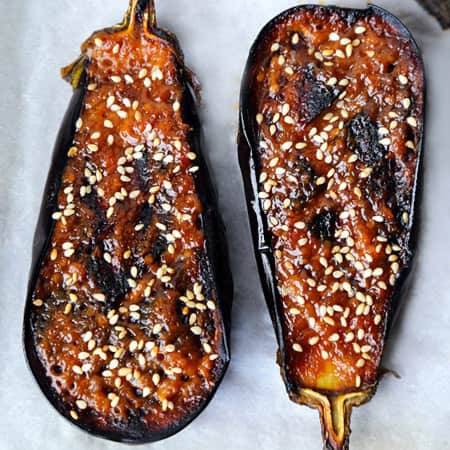
Ever wondered how to get that perfectly tender, melt-in-your-mouth eggplant without any bitterness? The secret is a quick saltwater soak! This simple step transforms the humble eggplant, setting the stage for our star dish: Miso Glazed Eggplant, or Nasu Dengaku. This classic Japanese recipe balances the deep, savory umami of miso with a touch of sweetness, all caramelized under the broiler to create an irresistibly glossy glaze. It’s a restaurant-quality side dish that’s surprisingly simple to make at home. Get ready to fall in love with eggplant all over again!
Ingredients
• 4 Japanese eggplants or 2 medium globe eggplants
• 4 tbsp salt
• 1 cup / 275 g miso paste
• 4 tsp sugar
• 4 tsp mirin
• 2 tbsp sesame oil
• Toasted sesame seeds, for garnish
Instructions
1. Prep & Soak the Eggplant: Cut the eggplants in half lengthwise. In a large bowl, dissolve the salt in lukewarm water. Submerge the eggplant halves, using a plate to keep them weighted down, and let them soak for 10 minutes.
2. Create the Miso Glaze: While the eggplant soaks, combine the miso paste, sugar, and mirin in a small saucepan over medium heat. Stir constantly until the sugar dissolves and the mixture is smooth. Remove from heat and set aside.
3. Roast the Eggplant: Preheat the oven to 400°F / 200°C. Remove the eggplant from the saltwater and pat completely dry. Score the cut side in a diamond pattern, then rub all over with sesame oil. Place cut-side down on a baking sheet and roast for 5 minutes until tender.
4. Glaze & Broil: Switch the oven to a high broil. Flip the eggplant halves so the cut side faces up. Brush generously with the miso glaze, sprinkle with toasted sesame seeds, and broil for 2-3 minutes until the glaze is bubbly and caramelized. Watch closely to prevent burning.
5. Serve: Remove from the oven and serve immediately while hot.
Nutritional Information
• Serving Size: 1 servingCalories: 250 kcalCarbohydrates: 30 gProtein: 7 gFat: 12 gSodium: 850 mg
Pro Tips
• White miso (Shiro Miso) provides a milder, sweeter flavor that’s perfect for this dish. For a deeper, more robust taste, try using red miso (Aka Miso).
• Scoring the eggplant in a crosshatch pattern not only looks beautiful but also helps it cook evenly and allows the delicious miso glaze to penetrate deeper.
• The sugar in the glaze can go from perfectly caramelized to burnt in seconds under the broiler. Keep a very close eye on it during the final step!
• For a complete meal, serve the miso eggplant over a bed of steamed rice and alongside some pickled ginger or a simple cucumber salad.
FAQ
Q: Is this miso eggplant recipe vegan
A: Yes, this Nasu Dengaku recipe is naturally vegan. All ingredients listed, including miso paste, mirin, and sugar, are plant-based. It’s a perfect choice for a fully plant-based Japanese dish.
Q: How can I add more protein to this dish
A: To make this a more protein-rich vegetarian meal, serve it alongside pan-fried firm tofu, edamame, or a hearty lentil soup. You can also top the finished eggplant with a sprinkle of hemp seeds for an easy protein boost.
Q: What can I serve with Nasu Dengaku to make it a full vegetarian meal
A: Transform this side dish into a satisfying main by serving it over a bed of steamed Japanese rice or quinoa. Pair it with a simple cucumber and wakame salad and a bowl of miso soup for a complete and balanced vegetarian meal.
Q: Can I make this recipe gluten-free
A: Absolutely. To ensure this recipe is gluten-free, choose a miso paste that is explicitly labeled gluten-free, as some varieties contain barley. Most white (shiro) miso is gluten-free, but always check the label to be certain.