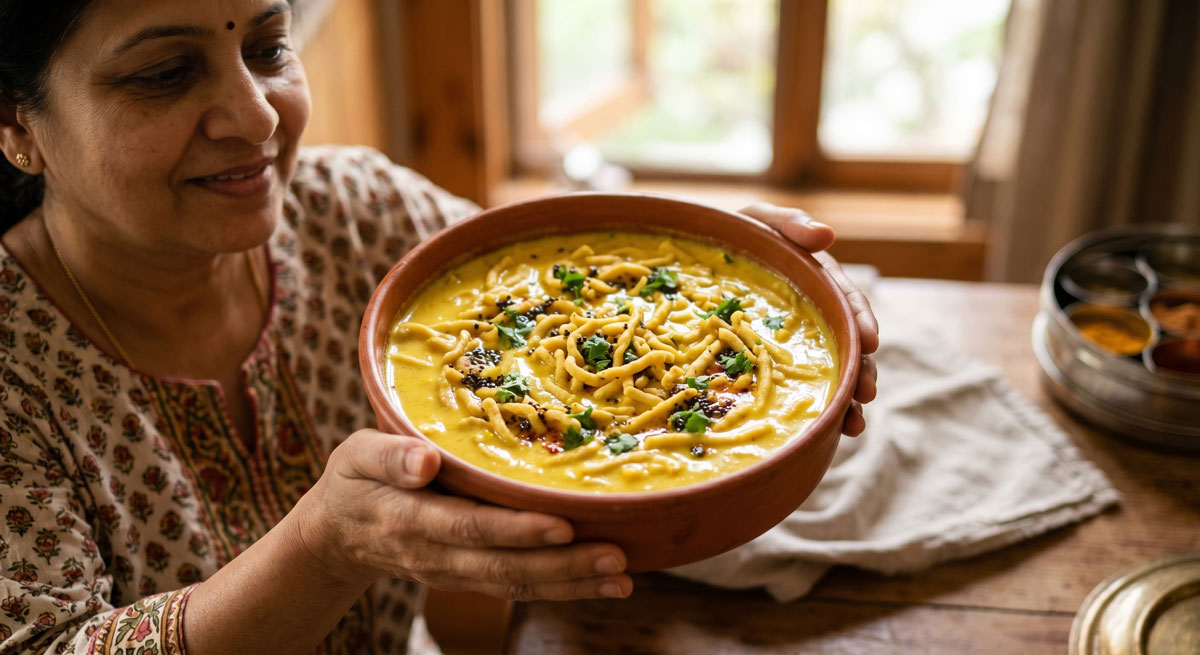
Ingredients for Besan Sev Karhi
For the Homemade Noodles (Sev):
- 0.5 cup (1.75 oz / 50 g) sifted chickpea flour (sift before measuring)
- 0.25 tsp. (0.05 oz / 1.5 g) salt
- 0.5 tsp. (0.04 oz / 1 g) ajwain seeds
- 0.25 tsp. (0.03 oz / 0.7 g) paprika (or 0.12 tsp. / 0.01 oz / 0.3 g cayenne pepper)
- 0.5 tsp. (0.08 oz / 2.5 g) melted unsalted butter
- 1 tbsp. plus 0.5 to 1.5 tsp. (0.5 oz to 0.7 oz / 15 g to 22 g) water
For the Besan Sev Karhi Sauce:
- 4 tbsp. (0.88 oz / 25 g) sifted chickpea flour
- 0.5 tsp. (0.04 oz / 1.2 g) ground cumin
- 1 tsp. (0.06 oz / 1.8 g) ground coriander
- 1 tsp. (0.1 oz / 3 g) turmeric
- 0.25 tsp. (0.03 oz / 0.7 g) cayenne pepper or paprika
- 1 tsp. (0.2 oz / 6 g) salt
- 2 cups (16.9 oz / 480 g) water (divided)
- 2 cups (16.9 oz / 480 g) plain yogurt, stirred until smooth
- 2 tbsp. (1 oz / 28 g) ghee or coconut oil
- 1 tsp. (0.1 oz / 3 g) black mustard seeds
- 3 tbsp. (0.1 oz / 3 g) chopped fresh coriander or minced parsley
Step-by-Step Directions
- Place the 0.5 cup (1.75 oz / 50 g) chickpea flour in a small mixing bowl, adding the salt, spices, melted butter, and exactly 1 tbsp. plus 0.5 tsp. (0.5 oz / 17 g) of water. Quickly gather the mixture into a stiff dough, adding tiny sprinkles of additional water only as necessary to make the noodle dough workable without becoming sticky, then knead until smooth and divide into 10 equal balls.
- Place a dough ball on a clean, smooth work surface and use your palms or fingers to evenly roll it into a thin, long rope about 0.25 to 0.5 inches (6 mm to 1.5 cm) thick. Cut the rope with a sharp knife into 0.5-inch (1.5 cm) lengths, repeat with the remaining balls, and keep the finished noodles covered in a small dish so they do not dry out.
- Bring 2.5 to 3 quarts (84.5 oz to 101.4 oz / 2400 g to 2880 g) of lightly salted water to a rolling boil over high heat in a large saucepan. Strew in the homemade noodles, taking care that they do not stick together, reduce the heat to moderate, gently boil for 8 to 10 minutes, then remove the pan from the heat, drain the noodles through a fine-meshed sieve, and set them aside.
- Prepare the karhi sauce base by combining the 4 tbsp. (0.88 oz / 25 g) chickpea flour, cumin, ground coriander, turmeric, cayenne, and salt in a large bowl. Slowly whisk in 4 tbsp. (2 oz / 60 g) of the measured water to form a completely smooth batter, then gradually pour in the remaining water and the 2 cups (16.9 oz / 480 g) of yogurt, whisking continuously until the mixture achieves a perfectly smooth consistency.
- Pour the blended karhi sauce into a medium saucepan and place it over moderate heat, stirring constantly until it comes to a full boil to prevent the yogurt from splitting. Reduce the heat to low, simmer the sauce uncovered for 10 to 12 minutes to cook out the raw flour taste, then carefully drop in the reserved cooked noodles and simmer gently for an additional 3 to 4 minutes.
- Heat the 2 tbsp. (1 oz / 28 g) ghee or coconut oil in a small saucepan over moderate heat until hot but not smoking. Toss in the 1 tsp. (0.1 oz / 3 g) black mustard seeds and fry just until they turn gray and begin to pop, then immediately pour this tempered spice mixture directly into the simmering karhi. Remove the pot from the heat, give it a gentle stir, cover with a tight-fitting lid to trap the aromas for 3 to 4 minutes, and serve warm garnished with the 3 tbsp. (0.1 oz / 3 g) of chopped fresh herbs.
Nutritional Information
Note: The following nutritional values are approximate calculations per serving based on a 6-serving yield using standard whole-milk plain yogurt.
- Calories: 139 kcal
- Carbohydrates: 11g
- Protein: 6g
- Fat: 8g
Pro Tips
- Prevent Yogurt Curdling: The secret to a silky-smooth karhi is constant stirring during the initial heating phase. Do not walk away from the pot until the yogurt mixture comes to a full, rolling boil. Using room-temperature yogurt also drastically reduces the risk of the sauce splitting.
- Sift for Smoothness: Never skip sifting the chickpea flour (besan). Chickpea flour is notoriously clumpy, and sifting it before whisking ensures your karhi batter remains lump-free and perfectly velvety.
- Low-Carb Alternatives: If you are adapting this recipe for a ketogenic audience, traditional chickpea flour will not fit the macros. You can successfully swap the besan in the sauce for a blend of unflavored whey protein isolate and a pinch of xanthan gum for thickening, and use a firm, low-carb lupin flour dough for the noodles.
- Master the Tadka (Tempering): The final tempering of mustard seeds in hot ghee is what gives this dish its authentic depth. Wait until the ghee is shimmering hot before adding the seeds; they should immediately pop and turn gray. Pour it into the karhi immediately to capture those volatile, aromatic essential oils.
Frequently Asked Questions (FAQ)
Why did my Karhi sauce curdle and how do I fix it? Karhi usually curdles if the yogurt is added while it's too cold, or if the heat is turned up too high without constant stirring. To prevent this, always whisk the yogurt with room-temperature water until completely smooth before heating, and stir continuously until it boils. If it has already slightly separated, an immersion blender can sometimes help bring the emulsion back together.
Can I make Besan Sev Karhi ahead of time? Yes, this dish is excellent for meal prep because the spices continue to meld and deepen in flavor overnight. Store the karhi and the boiled noodles in separate airtight containers in the refrigerator for up to 3 days. Reheat the sauce gently on the stove, thinning it with a splash of warm water if it has thickened too much, and add the noodles just before serving.
Is Besan Sev Karhi naturally gluten-free? Yes! Because authentic Besan Sev Karhi uses 100% chickpea flour (besan) for both the noodles and the thickening of the sauce, it is completely free of wheat and gluten. Always verify that your spices are certified gluten-free if catering to severe allergies.
Can I freeze the homemade chickpea noodles? It is best to freeze the dough or the shaped, uncooked noodles rather than the boiled ones. To freeze, shape the noodles and place them in a single layer on a parchment-lined baking sheet until solid, then transfer them to a freezer-safe bag for up to 3 months. You can drop them directly from the freezer into boiling water, adding an extra minute or two to the cooking time.