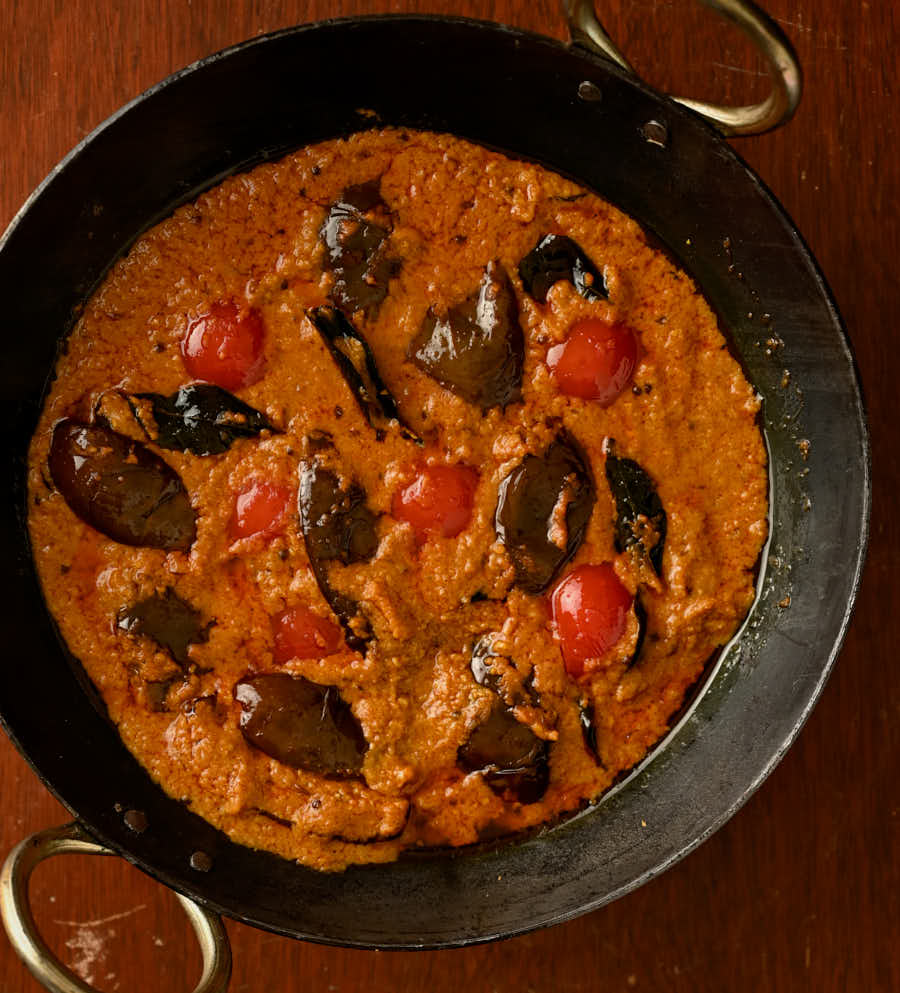
I’ve always been captivated by Baghara Baingan, one of Hyderabad’s most iconic vegetarian dishes. The traditional version, with its deep, nutty, sweet-and-sour sauce clinging to tender stuffed eggplants, is a culinary masterpiece. But let’s be honest, it’s a labor of love, involving numerous complex steps. I wanted to capture that same soul-satisfying flavor in a fraction of the time, without sacrificing authenticity. My version cuts down the process, not the taste. We still have a rich list of ingredients that build incredible depth, but the cooking itself is straightforward. The result is a luscious, aromatic curry that works beautifully for a weeknight treat or as the star of a dinner party, especially when served with a fluffy pilaf.
Ingredients
• (Serves 6)
• 2 lbs or 900g medium Italian eggplants, about 3
• 8 tablespoons or 120 ml olive or peanut oil, divided
• 1 tablespoon or 15g peanut butter, freshly ground is best
• 1 tablespoon or 15g tahini
• 1 tablespoon or 15g tomato purée
• 2 tablespoons or 30g dark brown sugar
• 1½ teaspoons or 7.5 ml tamarind concentrate
• ½ teaspoon or 2g whole brown mustard seeds
• ½ teaspoon or 2g whole cumin seeds
• 6–8 fresh curry leaves, lightly crushed
• 1 large onion, about 8 oz or 225g, peeled and finely chopped
• 1 tablespoon or 15g fresh ginger, peeled and finely grated
• 1 tablespoon or 15g garlic, peeled and finely chopped
• ¼ teaspoon or 1g ground turmeric
• 1 teaspoon or 3g ground coriander
• 1 teaspoon or 3g ground cumin
• ¼–¾ teaspoon or 1-3g red chili powder, to taste
• 1¼ teaspoons or 7g salt, or to taste
• 3 cups or 720 ml boiling water, divided
Instructions
1. Prep the Eggplant: Cut the eggplants lengthwise into quarters, then slice them crosswise into 1½ inch pieces.
2. Fry the Eggplant: Pour 6 tablespoons of oil into a large nonstick wok or frying pan over medium-high heat. Once hot, add the eggplant pieces and fry until lightly browned and about three-quarters cooked. Use a slotted spoon to transfer them to a bowl and set aside.
3. Mix the Sauce Base: In a separate bowl, whisk together the peanut butter and tahini. Slowly pour in 1 cup of boiling water, whisking continuously to form a smooth paste. Stir in the tomato purée, brown sugar, and tamarind concentrate, followed by another 1 cup of boiling water. Mix well and set aside.
4. Temper the Spices: Add the remaining 2 tablespoons of oil to the same pan over medium-high heat. When the oil is hot, add the mustard seeds. As soon as they begin to pop (this takes only seconds), add the cumin seeds and sizzle for a few moments. Carefully add the crushed curry leaves—they will splutter—followed immediately by the chopped onion.
5. Sauté the Aromatics: Stir and fry the onion for about 3 minutes until it begins to brown. Reduce the heat to medium-low and continue to cook for another 2-3 minutes. Add the grated ginger and chopped garlic, and stir for 2 minutes until fragrant.
6. Build the Masala: Add the turmeric, ground coriander, ground cumin, and chili powder to the pan. Stir for one minute, then pour in 1 cup of water. Bring to a simmer and cook on low heat for 8–10 minutes to develop the flavors.
7. Combine and Simmer: Pour the prepared peanut sauce into the pan. Cook gently for 5 minutes, stirring constantly. Add the fried eggplant and salt. Continue to cook on low heat for about 10 more minutes, stirring occasionally, until the eggplant is tender but still holds its shape. The sauce should be thick and luscious. If it becomes too thick at any point, stir in a splash of water.
Nutritional Information
• Calories: Approx. 380-450 kcal per serving
• Key Nutrients: Eggplant provides dietary fiber and antioxidants. Peanuts and sesame seeds offer healthy fats, protein, and essential minerals.
• Health Boost: Spices like turmeric contain anti-inflammatory compounds. This dish is a flavorful way to enjoy a variety of plant-based .
• Note: is an estimate and can vary based on specific used.
Pro Tips
• For the best texture, use small, firm eggplants. They tend to be less bitter, have fewer seeds, and absorb less oil while cooking.
• This curry tastes even better the next day as the flavors meld and deepen. Reheat it gently on the stovetop, adding a splash of water to loosen the sauce to your desired consistency.
• For an ultra-smooth gravy, you can blend the cooked onion-spice mixture with a splash of water before adding the peanut sauce to the pan.
• Don’t be afraid to taste and adjust the final dish. If it’s too tangy, add a pinch more sugar. If it needs more brightness, a tiny squeeze of lime juice can lift all the flavors.
FAQ
Q: Is this Baghara Baingan recipe vegan
A: Yes, this recipe is naturally vegan as written. It uses olive or peanut oil instead of traditional ghee and contains no dairy or other animal products. It’s a delicious and completely plant-based Indian dish.
Q: Can I make this curry without peanuts or tahini due to an allergy
A: While peanuts and sesame (tahini) are key to the authentic nutty flavor, you can make substitutions. For a peanut-free version, try using cashew butter or almond butter. For a sesame-free version, sunflower seed butter can be used as an alternative to tahini. Please note these changes will alter the traditional taste but still result in a delicious curry.
Q: How can I add more protein to this vegetarian dish
A: To boost the protein content, you can add a can of drained chickpeas or some pan-fried firm tofu cubes along with the eggplant in the final simmering step. This makes the curry an even more substantial and nutritionally complete vegetarian meal.
Q: How should I store leftovers and is this recipe good for meal prep
A: This curry is excellent for meal prep. Store it in an airtight container in the refrigerator for up to 4 days. The flavors actually deepen and improve overnight. Reheat gently on the stovetop, adding a splash of water to loosen the sauce to your desired consistency.