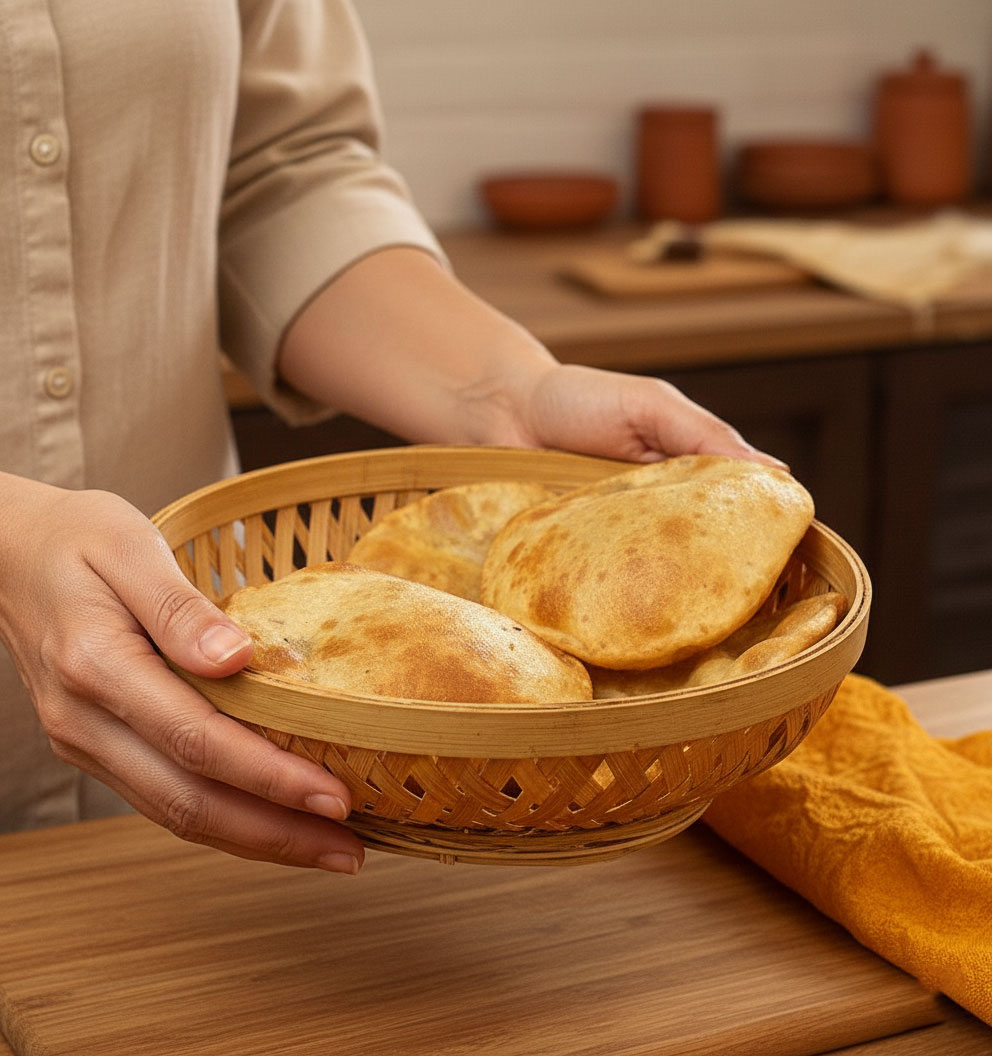
There are some food memories that transport you right back to a specific time and place. For me, these Masala Pooris take me to my first winter in Delhi. I had the honor of meeting a wonderfully kind and knowledgeable gentleman who, despite his busy schedule, personally introduced me to the heart of his home: the kitchen. It was there, amidst the fragrant spices and bustling energy, that I first tasted this incredible deep-fried bread. The resident chefs shared their secrets, and this recipe was the first treasure I collected. These spiced pooris aren’t just a side dish; they’re a star. In Delhi, the combination of Masala Poori and a rich kidney bean curry (Rajma) is the stuff of Sunday brunch legends. It’s a complete, soul-satisfying meal that brings warmth and flavor to any table. Now, I’m so excited to share that little piece of Delhi magic with you.
Ingredients
• 🥣
• For the Dough
• Flour (Choose ONE)
• Option 1: 2 cups / 260 g sieved chapati flour
• Option 2: 1.5 cups / 165 g whole wheat pastry flour AND 0.5 cup / 85 g fine-grain semolina
• 0.5 tsp / 2 ml salt
• 0.25 tsp / 1 ml cayenne pepper or paprika
• 0.25 tsp / 1 ml turmeric
• 2 tsp / 10 ml ground coriander
• 0.5 tbsp / 7 ml ground cumin
• 2 tbsp / 30 ml melted ghee or vegetable oil
• Approx. 2/3 cup / 160 ml warm water, about 100°F / 38°C
• For Frying
• Ghee or vegetable oil for deep-frying
• Note: If you can’t find fine semolina, process farina in a coffee grinder until it’s a fine powder, then sieve and measure.
Instructions
1. 📋
2. Prepare the Dough
3. In a large mixing bowl, whisk together your chosen flour, salt, cayenne, turmeric, ground coriander, and ground cumin.
4. Drizzle the 2 tbsp of melted ghee or oil over the flour. Use your fingertips to rub the fat into the flour until it resembles coarse breadcrumbs.
5. Pour in about half the warm water and begin mixing to form a shaggy dough. Continue adding water in small splashes until you have a pliable but moderately stiff dough. You may not need all the water.
6. Transfer the dough to a clean work surface and knead for 8 minutes until it’s silky smooth. Lightly oil your hands if needed.
7. Form the dough into a ball, rub it with a little oil, and cover with an inverted bowl. Let it rest for at least 30 minutes or up to 3 hours at room temperature.
8. Roll the Pooris
9. After resting, briefly knead the dough again. Divide it into 16 equal pieces.
10. Roll each piece between your palms to form a smooth ball. Keep the dough balls covered with a damp cloth to prevent them from drying out.
11. Take one ball and flatten it into a small disc. Dip a corner in a tiny bit of oil (this works better than flour for preventing sticking).
12. On your work surface, roll the disc into a 5-inch / 12.5 cm round of even thickness.
13. Place the rolled poori on a baking sheet and cover with plastic wrap. Repeat with the remaining dough balls, laying them in a single layer.
14. Fry the Pooris
15. Pour ghee or oil to a depth of 3 inches / 7.5 cm in a wok, karai, or Dutch oven. Heat over medium-high heat to 365°F / 185°C.
16. Gently slide one poori into the hot oil. It will sink and then quickly float to the surface.
17. As it rises, use the back of a slotted spoon to gently press it down into the oil. This pressure is the secret to making it puff up perfectly.
18. Once puffed and golden on the first side (about 30 seconds), flip and fry the other side until lightly browned.
19. Remove with the slotted spoon, allowing excess oil to drip off. Place on a paper-towel-lined tray to drain.
20. Repeat with the remaining pooris, ensuring the oil temperature remains stable.
Nutritional Information
• 🥗
• (Per poori, approximate)
• Calories: 115 kcal
• Carbohydrates: 14 g
• Protein: 2 g
• Fat: 6 g
• Sodium: 75 mg
Pro Tips
• ⭐ for Perfect Pooris
• The dough should be pliable but firm. If it’s too soft, the pooris will absorb excess oil; if it’s too hard, they won’t puff up.
• Don’t skip the resting time! This step relaxes the gluten, making the dough easier to roll and resulting in softer, fluffier pooris.
• Use a little oil instead of flour when rolling out the pooris. This prevents the frying oil from becoming cloudy and burnt with excess flour.
• The key to a perfectly puffed poori is to gently press it down with the back of a spoon as it starts to rise in the hot oil.
• Maintain a consistent oil temperature of 365°F / 185°C. A kitchen thermometer is your best friend for achieving crispy, non-greasy results.
FAQ
Q: Can I make this masala poori recipe vegan
A: Yes, this recipe is easily made vegan. Simply use vegetable oil instead of ghee for both the dough and for deep-frying. The recipe already provides this as an option for a delicious, plant-based result.
Q: What vegetarian dishes go well with Masala Poori
A: Masala Poori is incredibly versatile. For a classic and hearty vegetarian meal, serve it with Rajma (kidney bean curry) as mentioned. It also pairs wonderfully with Chana Masala (chickpea curry), Aloo Gobi (potato and cauliflower), or a simple bowl of cooling yogurt raita.
Q: How do I store leftover Masala Pooris
A: While Masala Pooris are best enjoyed fresh and hot, you can store leftovers. Let them cool completely, then place them in an airtight container at room temperature for up to 24 hours. They will lose their crispness but can be gently reheated on a pan.
Q: Can I make these pooris healthier without deep frying
A: For a healthier, lower-fat version, you can try baking or air-frying the rolled dough. Brush them lightly with oil and bake at 400°F / 200°C or air-fry at 375°F / 190°C until golden and puffed. Note that the texture will be different—more like a baked cracker than a soft, puffy poori—but still delicious.