
This recipe uses mashed potatoes bound with seasoned flour to create an exceptionally silky-smooth dough. Though a blend of whole wheat and barley flour is recommended, this poori is also excellent using all wheat or an unbleached white-wheat flour combination.
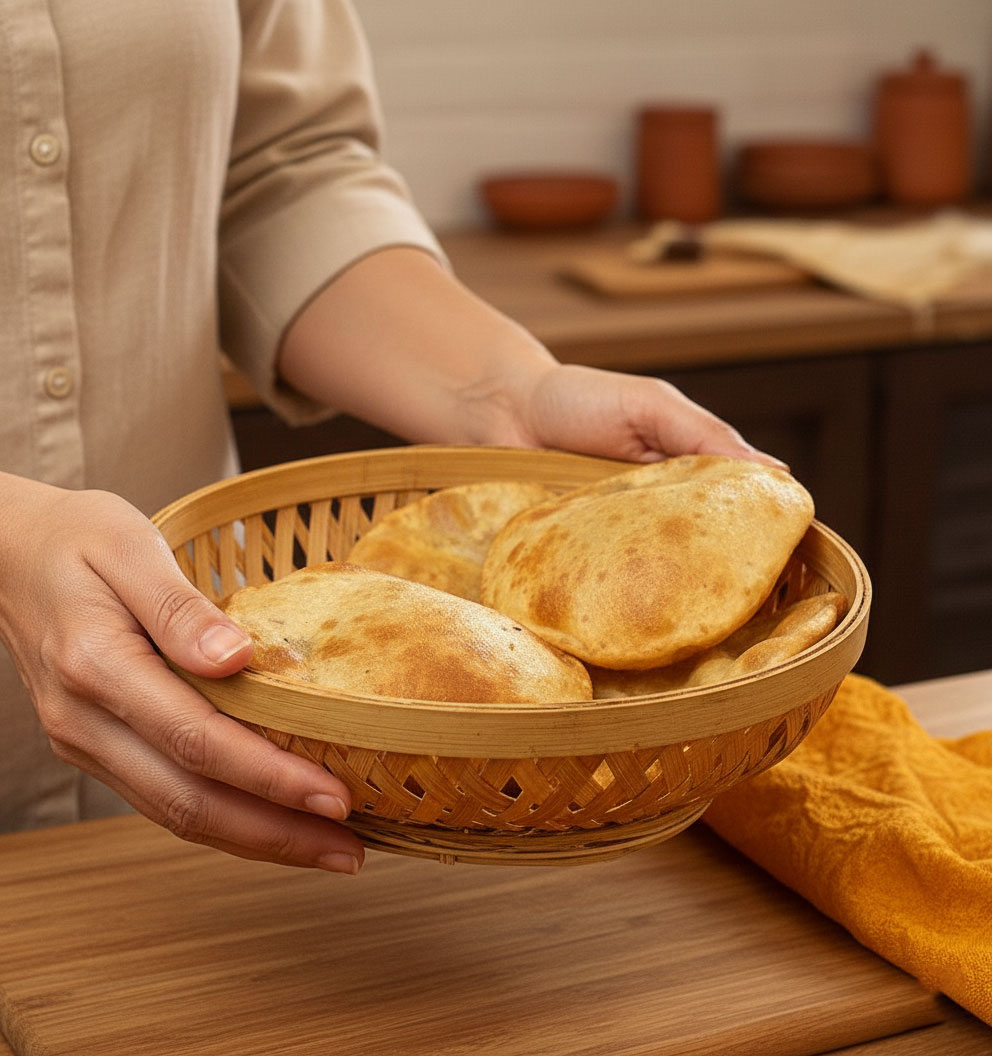
Initially, keep the dough quite stiff, as it softens considerably upon resting. These pooris are best when browned more than other types, making them especially crisp and golden. They tend to hold their puffed balloon shape longer than most breads.
For a late-morning breakfast or brunch, try them with fresh fruit or savory dishes. For a light lunch or dinner, they complement any number of salads or vegetables.
Preparation Time: 5–15 minutes Dough Resting Time: 0.5 – 3 hours Cooking Time: 0.5 hours (30 minutes) Makes: 16 pooris
Ingredients
• 2 medium-sized boiling potatoes (8 ounces / 230 g), freshly boiled or steamed in skins
• 1 cup (4.76 ounces / 135 g) sieved chapati flour OR 1 cup (3.7 ounces / 105 g) whole wheat pastry flour
• 1 cup (4.23 ounces / 120 g) barley, soya, or unbleached white flour
• 0.75 tsp (3.5 ml) salt
• 1 tsp (5 ml) garam masala
• 1 tsp (5 ml) ground cumin
• 0.25 tsp (1 ml) paprika or cayenne pepper (this amount adds significant heat; use less for milder pooris)
• 3 tbsp (45 ml) melted ghee or vegetable oil
• Ghee or vegetable oil for deep-frying
Instructions
1. Prepare the Potatoes: While the potatoes are still warm, peel them. Press them through a potato ricer or a coarse sieve. You should have about 1.67 cups (400 ml), loosely packed. Set aside.
2. Mix Dry Ingredients: In a large mixing bowl, combine the flours, salt, garam masala, cumin, and paprika or cayenne. Blend well.
3. Form the Dough: Rub the riced potatoes and 3 tbsp of melted ghee (or oil) into the flour mixture until the ingredients are thoroughly blended. At this point, the mass should start to come together. Add dribbles of water or sprinkles of flour as needed until you can form a firm dough ball.
4. Knead and Rest: Knead the dough on a clean surface for about 8 minutes. Form it into a smooth ball. Rub the ball with ghee or oil, cover it with an inverted bowl, and let it rest for 0.5 to 3 hours.
o Note: If resting longer, seal it well in a refrigerator for up to 24 hours. Remove it at least 1 hour before use.
5. Set Up for Frying: Gather your rolling pin, two or three cookie sheets, a slotted spoon, and a tray lined with double-thick paper towels for draining.
6. Divide the Dough: Place the rested dough on a work surface and knead it briefly. If the dough has softened too much, knead in flour as necessary to make it stiff enough to roll without extra flour. Divide the dough in half. Roll one portion into a rope 8 inches (20 cm) long.
7. Shape the Balls: Cut the rope into eight equal pieces. Roll each piece into a smooth ball. Place the balls on a plate without letting them touch and cover them with a damp cloth. Repeat this process for the other half of the dough.
8. Roll the Pooris: (You can roll and fry one by one, or roll all of them first).
o Take one ball of dough, keeping the remaining ones covered. Flatten it into a 2-inch (5 cm) patty.
o Dip a corner of the patty in a little melted ghee or oil (this helps prevent sticking).
o Roll it out, exerting firm but even pressure, into a 5-inch (12.5 cm) round.
o Place the rolled poori on a cookie sheet. Continue rolling all pooris, laying them in a single layer so they do not touch. Cover them with plastic wrap.
9. Heat the Oil: Pour melted ghee or oil to a depth of 3 inches (7.5 cm) into a karai, wok, or deep-walled Dutch oven. Heat the oil over moderately high heat until it reaches 365°F (185°C).
10. Fry the Pooris: Lift one poori and carefully slip it into the hot oil so it remains flat. The poori will sink and then quickly rise to the surface.
11. Puff the Pooris: As the poori begins to rise, gently press it down with the back of the slotted spoon, submerging it under the oil. This pressure will cause it to puff into a steam-filled balloon. (Be careful not to tear the delicate crust).
12. Brown and Drain: When it is lightly browned on the first side, carefully turn it over and brown the second side. The total frying time is under one minute. Remove the puffed poori with the slotted spoon and let it drain on the paper towels.
13. Repeat: Repeat the procedure for all the pooris, adjusting the heat to maintain the oil at an even 365°F (185°C).
14. Serve or Store: Serve immediately.
o To keep the batch warm for up to 0.5 hours, place them on paper-towel-lined cookie sheets (overlapping very slightly) in a preheated 275°F (135°C) oven.
o As pooris cool, they will deflate. At room temperature, these baasi pooris (leftover pooris) can be stacked and kept wrapped in a clean tea towel for up to 12 hours.