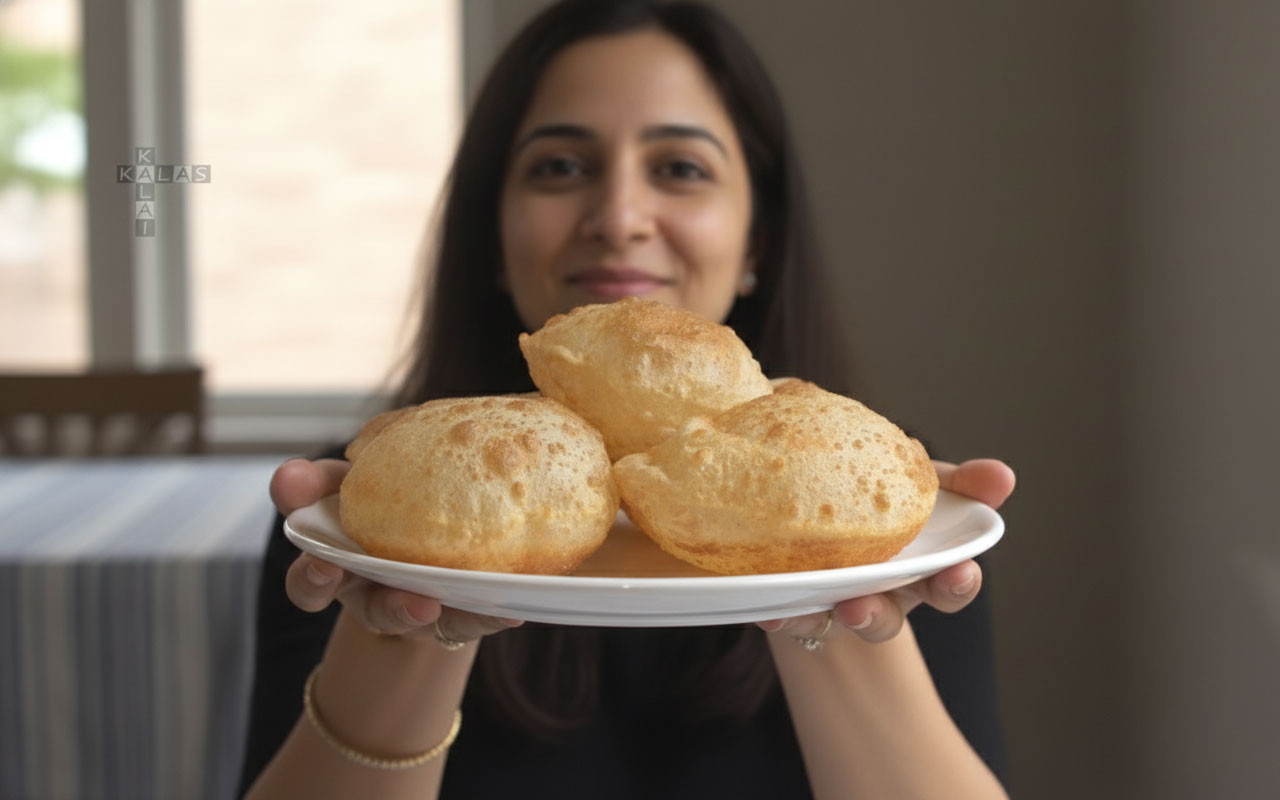
This recipe uses buttermilk for a soft, pliable dough. The exact amount of buttermilk may vary based on your flour’s absorbency; add just enough to form a stiff dough. For a variation in flavor and appearance, you can substitute the cumin with black poppy seeds.
Preparation time: 15 minutes Dough resting time: 30 minutes to 3 hours Cooking time: 30 minutes Makes: 16 pooris
🥣 Ingredients
• Flour: 2 cups sieved chapati flour (approx. 260 g / 9.2 oz)
o OR: 1 cup whole wheat flour (130 g / 4.6 oz) mixed with 1 cup unbleached white flour (120 g / 4.2 oz)
• Salt: 0.5 teaspoon
• Cumin: 1 tbsp coarsely crushed, dry-roasted cumin seeds (or 1 tbsp whole black poppy seeds)
• Pepper: 1 teaspoon freshly cracked black pepper
• Fat (for dough): 2 tbsp melted ghee or vegetable oil
• Buttermilk: 0.75 cup (180 ml) at room temperature, or as needed
• Frying: Ghee or vegetable oil for deep-frying
📝 Instructions
1. Make the Dough
• In a large mixing bowl, combine the flour, salt, cumin (or poppy seeds), and black pepper.
• Dribble the 2 tbsp of melted ghee or oil over the flour and rub it in with your fingertips.
• Initially, add 0.66 cup (160 ml) of the buttermilk and work the mixture into a mass.
• Knead, adding more buttermilk as necessary, until you have a dough that is stiff yet pliable.
• Transfer the dough to a clean work surface. Oil your hands and knead the dough for about 8 minutes until it is silky smooth.
2. Rest the Dough
• Rub the finished dough with a little ghee or oil and cover it with an inverted bowl.
• Let the dough rest at room temperature for at least 30 minutes or up to 3 hours.
• Note: For longer storage, you can keep it well-sealed in a refrigerator for up to 24 hours. Remove it at least 1 hour before use to let it come to room temperature.
3. Portion the Dough
• Place the rested dough on a clean work surface and knead it briefly. If the dough has softened too much, knead in a little extra flour.
• Divide the dough in half. Roll one portion into an 8-inch (20 cm) rope.
• Cut the rope into eight equal pieces. Roll each piece between your palms into a smooth ball.
• Place the balls on a plate (without letting them touch) and cover them with a damp cloth.
• Repeat the process with the other half of the dough.
4. Roll the Pooris
• Take one ball of dough, keeping the remaining ones covered. Flatten it into a 2-inch (5 cm) patty.
• Dip a corner of the patty in a little melted ghee or oil (this helps in rolling without using dry flour).
• Roll the patty out with firm, even pressure into a 5-inch (12.5 cm) round.
• Place the rolled-out poori on a cookie sheet. Continue to roll out all the pooris, laying them in a single layer without touching. Cover them with plastic wrap.
5. Fry the Pooris
• Pour ghee or oil to a depth of 3 inches (7.5 cm) in a karai, wok, or deep-walled pot.
• Heat the oil over moderately high heat until it reaches 365°F (185°C).
• Carefully slip one poori into the hot oil, ensuring it stays flat. It will sink and then quickly bob to the surface.
• As it rises, gently press it down into the oil with the back of a slotted spoon. This pressure is what causes it to puff into a balloon. (Do not press harshly, as a tear will cause it to absorb oil).
• Once puffed and lightly browned on the first side, flip it over and brown the second side. The total frying time is usually under one minute.
• Remove the puffed poori with the slotted spoon, drain it, and place it on a tray lined with paper towels.
• Repeat with the remaining pooris, adjusting the heat as needed to keep the oil at a consistent temperature.
6. Serve and Store
• To Serve Immediately: Pooris are best served hot.
• To Keep Warm: You can keep the batch warm for up to 30 minutes on a paper-towel-lined cookie sheet in a preheated 275°F (135°C) oven.
• To Store: At room temperature, leftover (baasi) pooris can be stacked and kept wrapped in a clean tea towel for up to 12 hours.